




You're on the firing line with your passive earmuffs clamped tight. The range officer calls something down the line, and you catch half of it. You lift one earmuff cup to ask him to repeat it, just as the shooter in the next bay fires and now you’ve got ringing in your ears that you can’t shake off.
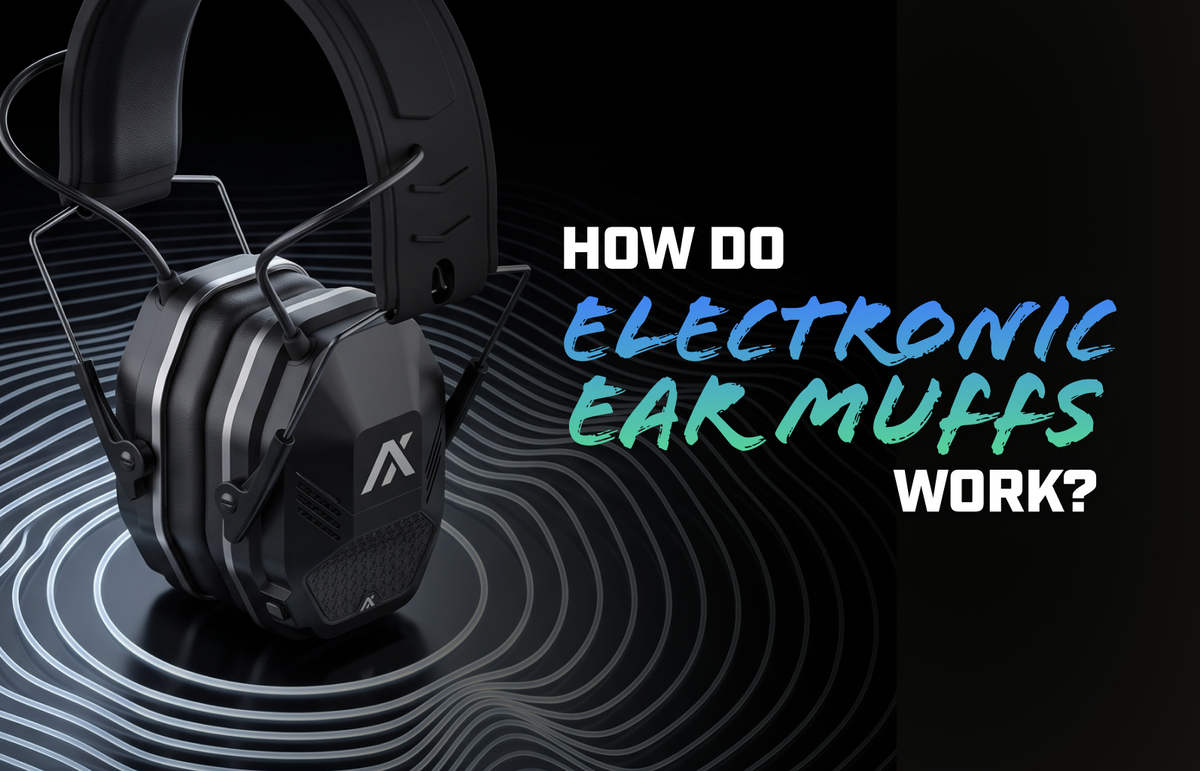
Electronic earmuffs are built so you never have to lift that cup. Microphones on the outside of each earmuff cup can pick up the sounds around you, and a chip amplifies soft sounds while turning down anything above a set threshold.
AXIL's electronic line includes models such as the XCOR, GS Extreme 3.0 and TRACKR, which set that threshold at 85 dB. The sealed earmuff cup provides its rated passive protection the whole time. Electronic earbuds and earplugs work the same way in a smaller housing.
Inside a Pair of Electronic Ear Muffs

Three components sit inside a pair of electronic earmuffs and let you keep that cup on your ear: the sealed cup itself, a set of outside microphones, and a processor with a small speaker.
Sound reaches your ear along two separate paths, and only one of those paths runs through the electronics.
The Sealed Earmuff Cup Blocks Sound at All Times
Your earmuff cup is the part that protects your hearing. The cup's hard shell and soft cushion seal around your ear and block sound physically, whether the electronics are on or off.
Outside Microphones Pick Up the Sound Around You
A small microphone on the outside of each earmuff cup picks up softer sounds like range commands, voices, and footsteps. Quality units put one microphone on each side.
Two microphones let your brain compare left and right, so you can still tell which direction the sound of a voice or a snapped twig came from.
A Processor and Speaker Sit Inside Each Earmuff Cup
A chip inside the cup reads the microphone signal and decides how loud each moment of sound should be. A small speaker inside the same cup then plays that sound back to your ear. The chip can raise soft sounds, pass normal sounds through, and turn loud sounds down.
| Part | Where it sits | Job | Works without power? |
|---|---|---|---|
| Sealed cup and cushion | Around your ear | Blocks sound physically | Yes |
| Microphones | Outside each cup | Pick up outside sound | No |
| Processor | Inside each cup | Sets the playback level | No |
| Speaker | Inside each cup, facing your ear | Plays sound back to you | No |
Electronic earbuds and electronic earplugs carry the same parts in a smaller housing, with the ear tip doing the sealing. Read more about how to fit electronic ear plugs so that tip seals properly in our guide.
Of those parts, the processor decides what reaches your ear when a shot goes off.
Compression vs Clipping: What Happens When a Shot Goes Off
When a shot goes off, the processor inside your earmuff cup either compresses the sound or clips it. You’ll experience the difference in what you hear during the shot and in the second right after it.
Before the Shot, Soft Sounds Get Amplified
Up to the moment the shot breaks, the processor amplifies sound below its threshold. AXIL offers up to 5X hearing enhancement on the GS Extreme 3.0 and the MXII Pro, with adjustable levels so you can choose how much boost you hear. Softer sounds like a range officer's command or a hunting partner's whisper can come through louder than you'd hear it with bare ears.
Compression Turns the Shot Down and Keeps Voices Coming Through
Once the shot crosses the threshold, a compression circuit turns the playback down to a safe level. The XCOR, GS Extreme 3.0 and TRACKR set that threshold at 85 dB. NIOSH uses the same number for its recommended exposure limit, 85 dBA averaged over an eight-hour workday. Our decibel guide explains why 85 dB is the line where protection starts.
A compression circuit keeps passing sound through the shot at that lower volume, so a command spoken over the shot still reaches you.
Clipping Cuts Your Hearing Off for a Moment
Older and cheaper circuits clip loud sounds instead of compressing. A clipping circuit cuts the microphones entirely when the shot arrives, so you hear a moment of silence before sound returns. If your range partner was talking when the shot broke, you can lose the next few words.
| Moment | Compression circuit | Clipping circuit |
|---|---|---|
| Before the shot | Soft sounds amplified | Soft sounds amplified |
| As the shot breaks | Shot turned down to a safe level | Microphones cut out |
| Right after the shot | Voices keep coming through | Silence, then sound returns |
| Protection from the seal | Full rated NRR | Full rated NRR |
The industry name for this behavior is level-dependent hearing protection, because the protection changes with the sound level. You'll also see the broader label "active hearing protection" on some packaging.
Compression circuits come in analog and digital versions. A digital circuit can give the designer finer control over how sound is shaped. Our guide to choosing electronic hearing protection compares analog and digital circuits in more detail.
A compression circuit only helps if it reacts fast enough to catch the start of the shot, which is why so many boxes promise "instant" protection.
How Fast Is "Instant"? Reaction Time Explained
If you see the word "Instant" on a box of electronic hearing protection, that describes the circuit's reaction time, and every circuit takes some time to react.
Reaction time, also called attack time, is the difference between a sound crossing the threshold and the compression circuit turning that sound down.
Reaction Time Is Measured in Thousandths of a Second
Manufacturers list reaction time in seconds or milliseconds. A shorter reaction time lets less of a loud sound through the speaker before compression starts. One thing to look out for is whether a product publishes the figure at all, since many boxes say "instant" without giving a number.
AXIL's TRACKR Electronic Lists a 0.02 Second Reaction Time
The SIG SAUER TRACKR Electronic earmuffs use Sound Activated Compression - 0.02 second reaction time. That works out to 20 milliseconds between the sound of a gunshot crossing the threshold and the circuit turning that sound down.
Your Passive Seal Covers the Gap Before Compression Starts
During those milliseconds, your passive seal is already working. Your earmuff cup blocks the leading edge of the shot from the start, and the electronics only decide what gets added back through the speaker. For that reason, a sealed electronic earmuff gives you at least the protection of the same cup with the power off.
That passive layer carries a heavy load. NIOSH researchers report that firearms produce peak levels between 140 and 175 dB, and that an electronic protector's passive protection, measured with the electronics turned off, decides how much of a high-level impulse reaches you. You can see how loud a gunshot is for common firearms in our gunshot decibel guide.
The strength of that passive layer is printed on your box as the Noise Reduction Rating, and on electronic earmuffs that number often runs a little lower than on bulky passive earmuffs.
Why Electronic Ear Muffs Rate a Little Lower Than Passive Muffs
Two reasons explain why electronic earmuffs often carry a slightly lower NRR than passive earmuffs: the rating measures only the cup's passive seal, and the electronics take up room inside that cup.
The NRR Rates the Passive Seal of Your Earmuff Cup
The NRR on a pair of electronic earmuffs reflects the passive protection of the earmuff cup. The microphones, processor, and speaker sit on top of that rating and give you awareness of the sounds around you. A pair of electronic earmuffs earns its NRR the same way a passive pair does, through the cup and cushion.
Electronics and Low-Profile Cups Leave Less Room Inside
The microphones, circuit board, speakers, and batteries all take up space inside each earmuff cup. Many electronic earmuffs also use low-profile cups, which give up some internal volume so your cheek can rest on the rifle stock without the cup getting in the way. Less internal volume can cost a few decibels of passive protection.
How AXIL's Electronic Ear Muffs and Earbuds Rate
| AXIL product | Type | Rating | Rating note |
|---|---|---|---|
| MX Electronic | Earmuffs | 23 dB NRR (ANSI) | Per the MX Electronic certification |
| MXII Pro | Earmuffs | 22 dB NRR | Stores X20 or X30i earplugs in the cup |
| XCOR | Earbuds | 21 to 23 dB NRR | Foam tips rate higher |
| GS Extreme 3.0 | Earbuds | 21 dB NRR (foam), 17 dB NRR (silicone) | Tip material changes the rating |
On in-ear models, your ear tip choice changes the rating. That difference comes from how your hearing protectors fit, since a foam tip expands to seal your ear canal more completely than a silicone tip.
You can make up the difference by doubling up. If you shoot at an indoor range or behind a rifle with a muzzle brake, consider wearing earplugs under your earmuffs.
The MXII Pro holds a pair of AXIL X20 or X30i earplugs inside the earmuff cup so you have them when you need them. Our guide to doubling up covers how to do that effectively, and our guide to how NRR ratings work walks through the math for your real-world protection.
Because that rating belongs to the cup, your hearing protection stays in place when the battery runs out.
What Happens When Your Electronic Ear Muffs Run Out of Battery
When your electronic earmuffs run out of battery, the electronics stop and the earmuff cups keep protecting you at their rated NRR. You lose the hearing boost. That can change how everything around you sounds.
Your Protection Stays at the Rated NRR
A dead battery turns electronic earmuffs into passive earmuffs. The cup and cushion still seal around your ear, so the rating on the box still applies.
Voices Turn Muffled and Direction Gets Harder to Judge
Without power, the sound of voices and range commands will be muffled, and you may lose your sense of direction and speech clarity. The real risk starts when you lift a cup to hear better, because your ear is unprotected the moment that cup comes off.
How Long AXIL Batteries Last by Mode
Runtime drops when you add Bluetooth audio on top of hearing enhancement, so check the runtime for the mode you'll run most often.
| AXIL product | Hearing enhancement only | Bluetooth audio only | Both together |
|---|---|---|---|
| MXII Pro earmuffs | About 60 hours | About 45 hours | About 40 hours |
| GS Extreme 3.0 earbuds | Up to 40 hours | Up to 20 hours | Up to 15 hours |
| XCOR earbuds | Up to 13 hours | Up to 7 hours | Up to 5 hours |
Tip: Charge your electronic hearing protection the night before a range day or a hunt, and keep a pair of foam earplugs in your range bag as a backup.
Battery life is easy to plan around. Five other limits decide whether electronic earmuffs are worth it for the way you shoot.
Are Electronic Ear Muffs Worth It? Five Limits to Know
Electronic earmuffs can be worth it for you once you know their five limits and how to work around each one. Plenty of shooters have tried a pair, disliked them, and gone back to passive earmuffs, and those complaints usually trace back to one of these five problems:
1. A Broken Seal Lets Sound Leak Past Your Earmuffs
The arms of shooting glasses, your hair, and a poorly fitted ear tip can all break the seal of your hearing protection. When that happens, sound leaks straight past your earmuff cushion or earplug tip, and no circuit can make up for that leak.
Tip: Wear thin-armed shooting glasses under your earmuffs, or switch to earbuds and follow our steps on how to fit electronic ear plugs.
2. Amplifier Hiss Rises at High Gain
Every amplifier makes a little background sound of its own. This is called the noise floor. At high gain in still woods, you can hear that noise floor as a faint hiss, and cheaper units tend to hiss more.
Tip: Set your hearing enhancement to the lowest level that still lets you hear range commands or your hunting partner. You'll get less hiss and longer battery life.
3. Wind Gets Amplified Along With Everything Else
Wind hitting the outside microphones of your hearing protection gets amplified like any other sound. AXIL’s newer MX II platform is designed to reduce wind noise. Our hunting guide covers wind noise on electronic hearing protection by hunt type.
4. Cheap Circuits Clip Instead of Compressing
If your electronic earmuffs go silent after every shot and then come back muffled, the circuit is clipping or reacting slowly. Look for a compression circuit with a published reaction time to avoid that experience.
5. Noise-Canceling Headphones Can't Stand In for Electronic Ear Muffs
Active noise cancellation (ANC) headphones play an opposing sound wave to cancel steady, low-pitched noise like an engine hum. A gunshot is too sudden and too loud for that process to handle.
Consumer ANC headphones also usually carry no NRR, so you have no rated seal behind the electronics. Our articles explain why noise cancellation cannot stop a gunshot and how noise cancelling vs hearing protection compare.
| Limit | What you notice | How to fix it |
|---|---|---|
| Broken seal | Shots sound sharp and loud | Thin-armed glasses, reseat cups or tips |
| Amplifier hiss | Faint hiss in still settings | Lower the hearing enhancement level |
| Wind | Rushing sound at the microphones | Choose a model built for wind noise reduction |
| Clipping circuit | Silence after each shot | Choose a compression circuit |
| ANC headphones | No rated protection | Wear rated electronic hearing protection |
Each of those limits has a fix. Once your seal is tight and your gain is set low, electronic earmuffs give you their full rated protection with your hearing back, which can make them worth it for range days and hunts alike.
The strongest case for electronic earmuffs shows up when you compare how long you'll keep them on against a passive pair.
Passive vs Active Hearing Protection: Which Stays On Longer?
Active hearing protection, meaning electronic earmuffs and earbuds, usually stays on your ears longer than passive hearing protection. You can talk, listen, and hear commands with both cups sealed, so you have fewer reasons to take your protection off.
Passive Ear Muffs Come Off Every Time You Need to Hear
With passive earmuffs, you take one side off to talk to a partner, listen for game, or catch a range command. Each time that cup lifts, your ear is unprotected. Many hunters skip hearing protection altogether.
Electronic Ear Muffs Let You Talk and Listen With Both Cups Sealed
Hearing enhancement removes one big reason to take your hearing protection off, because you can still hear game, your partner, and movement around you.
That’s incredibly important because noise-induced hearing loss builds up over time, and the damage is permanent. Keeping both cups sealed through every shot protects you from that buildup.
| Situation | Passive earmuffs | Electronic earmuffs |
|---|---|---|
| Range officer gives a command | Lift a cup to hear it | Hear it with both cups sealed |
| Partner talks between strings | Lift a cup or shout | Talk at normal volume |
| Listening for game | Take the earmuffs off | Hear soft sounds amplified |
| A shot breaks mid-conversation | Exposed if a cup is lifted | Shot compressed, seal stays on |
Hearing clearly helps your shooting, too. Our article on the startle response explains how proper hearing protection can steady your performance on the line.
Four AXIL Options for Long Days on the Range
AXIL builds the same Protect + Enhance idea into each product, with different hardware for different days in the field.
XCOR earbuds use a digital compression circuit that turns loud noise down instead of shutting the microphones off. XCOR is rated 21 to 23 dB NRR depending on the ear tip, with up to 13 hours of Hear Control.
Best for: Shooters who want wireless in-ear protection that stays clear of the rifle stock.
GS Extreme 3.0 earbuds pair SonicShieldX filter-on-microphone technology with 85 dB compression. GS Extreme 3.0 is rated 21 dB NRR with foam tips and runs up to 40 hours on hearing enhancement alone.
Best for: All-day range sessions and hunts where you want up to 5X hearing enhancement in an earbud.
MXII Pro earmuffs combine SonicShieldX with a 22 dB NRR and about 60 hours of hear-through runtime. Each earmuff cup stores AXIL X20 or X30i earplugs for doubling up.
Best for: Indoor ranges and braked rifles, where you may want earplugs under your earmuffs.
SIG SAUER TRACKR Electronic earmuffs use AXIL's Autoblocker technology and list a 0.02 second reaction time.
Best for: SIG SAUER shooters who want electronic earmuffs with a published reaction time spec.
Common Questions About Electronic Hearing Protection
What is electronic hearing protection?
Electronic hearing protection is any earmuff, earbud, or earplug that combines a passive seal with microphones, a processor, and a speaker. The seal blocks harmful noise, and the electronics play back safe sounds such as voices and range commands.
Do electronic earbuds work the same way as electronic ear muffs?
Yes, electronic earbuds use the same microphones, processor, and speaker in a smaller housing. The ear tip provides the seal, so tip fit decides much of your protection.
Are electronic ear muffs better than passive?
Electronic earmuffs are better for awareness and wear time. Bulky passive earmuffs can carry a slightly higher NRR, so compare ratings for the place you shoot.
Do electronic ear muffs work without batteries?
Yes, with a dead battery, electronic earmuffs work as passive earmuffs at their rated NRR, and you lose only the hearing boost.
Do electronic ear muffs amplify gunshots?
Electronic earmuffs compress any sound above the threshold, including gunshots, to a safe playback level. The passive seal also blocks the gunshot the whole time.
Does Bluetooth reduce protection?
Bluetooth audio does not change the passive rating of your hearing protection, and the compression circuit still limits loud sounds while you stream. Keep the volume moderate so music or calls do not add to your overall noise exposure. Our guide to choosing electronic hearing protection covers Bluetooth models.
What does level-dependent mean?
Level-dependent is the industry term for hearing protection that changes with the sound level. Soft sounds get amplified, and loud sounds get turned down.
How do electronic ear defenders work?
Ear defenders is the UK term for earmuffs, and electronic ear defenders work exactly the same way as electronic earmuffs.
How to Choose and Test Your First Electronic Ear Muffs
Choosing your first pair of electronic ear muffs comes down to the seal, since the earmuff cup or ear tip does the protecting and the electronics give you your hearing back. Testing that seal on your first range day tells you whether the pair you chose is doing its job.
Choose Your Electronic Ear Muffs by Fit and Where You Shoot
Consider electronic earmuffs if you shoot from a bench and want the easiest seal. Consider electronic earbuds instead if your earmuff cup bumps your rifle stock or you wear thick shooting glasses. Then match the NRR to where you shoot, and plan to double up with earplugs indoors or behind a muzzle brake.
Test Your Electronic Ear Muffs on Your First Range Day
- Charge the battery the night before, and set the hearing enhancement to a low level.
- Seat the earmuff cups so the cushions sit flat against your head, with no glasses arms or hair under the seal.
- Ask a friend to keep talking at normal volume while someone fires on the line.
- Listen for whether the voice keeps coming through your hearing protection during the shot. If the voice keeps coming through, the compression circuit is working.
- If the shot still sounds sharp and loud, reseat your earmuff cups before you shoot again.
If you're deciding which pair to buy, our guide to choosing electronic hearing protection compares models by use case. You can also browse electronic earmuffs, electronic earbuds, or AXIL's full range of electronic hearing protection. The right pair lets you hear every range command with both ears sealed.



Share:
Industrial Hearing Protection: How to Pick the Right NRR for Your Plant Floor